
By Galen Simmons
It’s not about where you’re going, but who you are when you get there.
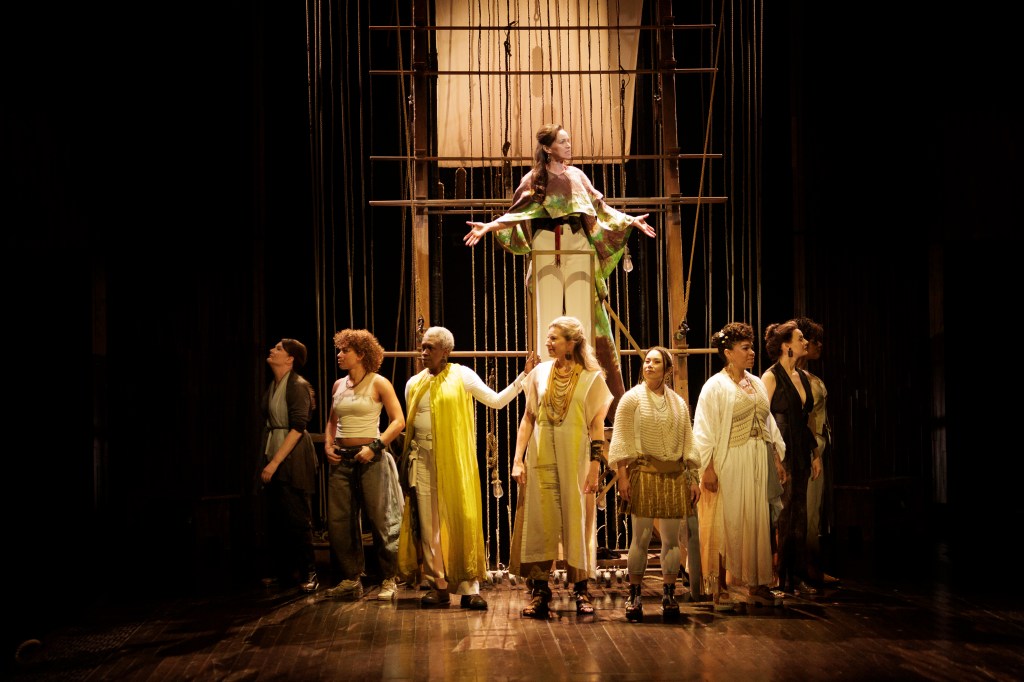
In the world premiere of playwright Erin Shields’ Ransacking Troy, as directed by Jackie Maxwell for the 2025 Stratford Festival, the classic Greek epics Homer’s Iliad and The Odyssey are reimagined with nine Greek women at their core, each with a strong connection to one major player in Homer’s original stories.
The play unfolds as each of the women takes turns telling their story and acting out all its parts after arriving back home in Greece at the end of their odyssey. On each leg of their journey, the women’s story mirrors that of Homer’s, only with the female perspective leading the decision-making, resulting in solutions to obstacles that men would have never thought of.
Instead of travelling to Troy to fight a decade-long war, the women travel to the walled city to broker some kind of piece and convince their husbands, fathers and brothers to come home after being away for so long.
Instead of building a giant, wooden horse as a deliberate ambush for the Trojans, they build it as a peace offering meant to be filled with gifts in exchange for the return of Helen and the war’s end, despite the men ultimately using it for their own violent purpose.
Instead of fighting with the Trojans, they use a clever ruse to trick the Greek men into thinking they’d angered Apollo before appearing before the men under the guise of gods themselves to convince them peace is the only way to end the war.
Once they felt they had ended the war with the Trojans, the women embark on their journey home with the goal of changing Greek society for the better with a greater emphasis on feminine influence.
After being knocked off course by a storm, they admire the Sirens for how they deal with the men they encounter, outright avoid the cyclops altogether, narrowly pull themselves back from being dragged into the entrance of Hades, find common ground with the goddess Circe and speed past the six-headed sea dragon, Scylla, suffering only one casualty before making it home relatively unscathed when compared to the male version of The Odyssey.
But still, the story ends the same. The women learn the men used their wooden horse as they did in Homer’s original epic, leading to the rape and murder of Trojan women and children. Despite this story being centred on women in a society that had been led and powered by women for a full decade, men – as they always seem to – still hold the power, ruling with their own selfish pride, honour and glory front and centre.
Yet in this play, it’s not about where the story ends, it’s about how each of the nine women grew into talented leaders, heroes, politicians, negotiators, craftspeople, warriors and problem solvers in their own rights, standing up for what they believe in and dedicating their lives to creating a world where they and their daughters are valued for more than their bodies.
With only nine women in the cast – Maev Beaty (Penelope), Irene Poole (Clytemnestra), Helen Belay (Electra), Sarah Dodd (Galax), Ijeoma Emesowum (Psamathe), Caitlyn MacInnis (Cur), Yanna McIntosh (Eurydice), Marissa Orjalo (Hermione) and Sara Topham (Aegiale) – each of the actors does an admirable job performing in many different roles.
Whether it’s as their husbands, fathers, brothers or sons for a quick comedic jab at the men’s expense, or as other pivotal women in the story, slipping offstage without the audience noticing and returning as Helen (Topham), Trojan Queen Hecuba (McIntosh), or the goddess Circe (Emesowum) among others, the actors’ timing and ability to embody each role without confusing the audience should be commended.
So, too, should the backstage crew in this production be commended. The use of a single set-piece, benches and ropes to create the ship and its oars, Circe’s giant loom, war encampments and more; the use of lighting to elicit the storm, sunlight and torches; and the production’s sound design, which leads the audience to imagine giant waves, a cyclops, a sea dragon and great battles between the Greeks and the Trojans, truly brought this play to life.
To me, it seemed this play was written specifically for the stage at the Tom Patterson Theatre, and I truly can’t imagine it being produced for any other space.
Ransacking Troy plays at the Tom Patterson Theatre until Sept. 28.
 NORTHERN ARTS PERSPECTIVE
Leave a comment