
By Galen Simmons
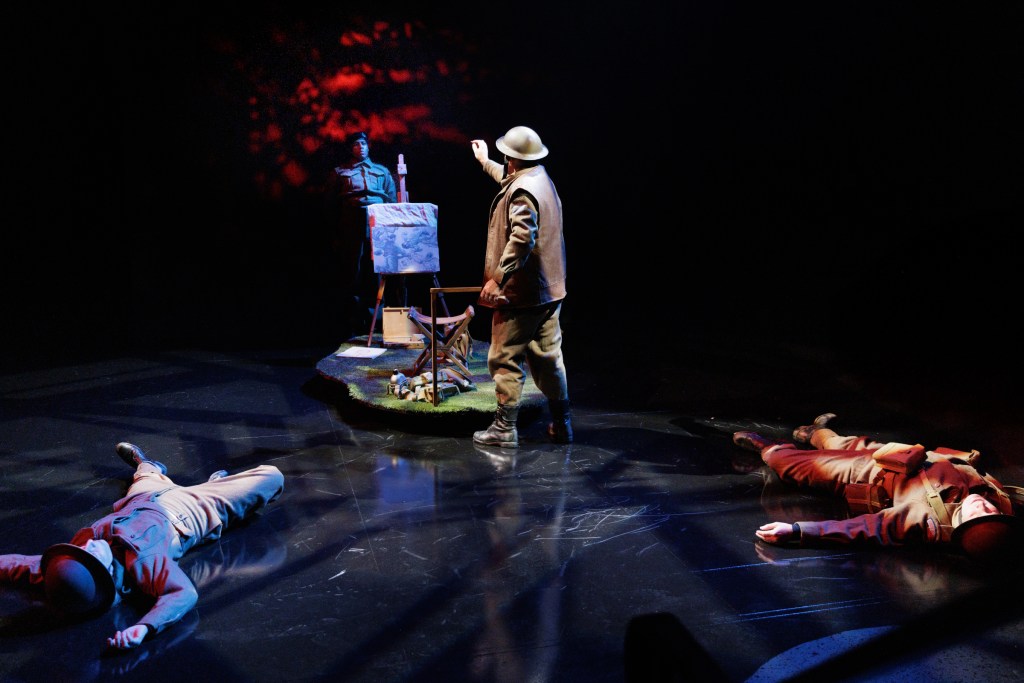
While photographs and historical accounts of war may tell us what happened, the emotions – the fear and anxiety of being attacked, the boredom of waiting for something to happen, the adrenalin-pumping excitement of action, and the crushing sadness of losing friends – can best be relayed to those of us who weren’t there through art.
In Yvette Nolan’s play, The Art of War, produced this season for the Stratford Festival’s Studio Theatre stage, Nick (Josue Laboucane), a young Canadian artist commissioned to paint the war effort on the front lines of the Second World War in Europe, struggles both with his role in the conflict and with how to depict the horror, hopelessness and carnage he witnesses to preserve those memories as part of the national consciousness and as part of our identity as Canadians.
Over the course of the play, Nick – who initially doubts his own talent and ability as an artist – refines his craft and gradually gains a better understanding of the importance of his work, as well as what that work really should be, through conversations with the people he meets.
Impactful lessons come from characters ranging from friend and fellow Canadian soldier Newman (Jordin Hall), who is shot and killed during a conversation with Nick early on in the play but continues to return to his still-living friend with important lessons for the artist either as a ghost or some PTSD-induced hallucination, to a Polish refugee named Magda (Jenna-Lee Hyde), who helps Nick better understand the toll the war has taken on people like her, whose lives were once peaceful and happy, before she dies of starvation in a Nazi concentration camp.
Another important conversation is had between Nick and Eva (Julie Lumsden), a wartime performer touring army bases in Europe, who helps the artist draw a line between what patrons of his oil paintings can accept and appreciate, and what horrors Canadians back home may not be able or willing to come to terms with.
German war painter and Nazi deserter Matthaeus (Rylan Wilkie) helps Nick understand the impact of the war on the other side of the battlelines, while conversations with Dennis (also played by Wilkie), an arrogant wartime photojournalist who believes photography has made painting obsolete, leads Nick to the understanding that his art has an important role in eliciting how it feels to be at war by those in the midst of it.
While the magic of this play lies in the depth of performance by each member of its cast, especially that of Laboucane, who skillfully portrays his character’s immense growth as the play progresses while bearing the mental anguish of everything he’s witnessed, the play’s beauty comes from the art created both by the actors onstage and by real wartime artists, reproductions of the latter from the Beaverbrook Collection of War Art are displayed with permission from the Canadian War Museum.
The art created by Nick and Matthaeus onstage includes rough sketches and drawings, unfinished watercolour paintings and more complete oil paintings, all of which are collected in crates or displayed on an easel perched on an expanding patch of grass from which Nick paints the world around him – one of the play’s very few set pieces – until it’s time for the young artist to pack up his work and head back to Canada.
The reproductions of the real war art, meanwhile, are displayed in backlit panels mounted above the left and right sides of the stage. Before the play, they are lit for the audience to study and appreciate, however once the play begins, they are not visible again until Nick as an old man visits his only two pieces on display at the Canadian War Museum and invites a museum guide, Heather (Lumsden), to see it with him.
Despite most of his wartime work being locked away in a warehouse, Nick says he is proud to see two of his paintings, as well as those by other wartime artists, on display at the museum for all to see.
This play is an entirely fascinating character study of a Canadian war artist as he grapples with a commission far beyond his initial understanding, yet finds a way to perform his duty to country while carrying the immense weight of horror, trauma and grief.
It also reminds us of the vital role art plays in our understanding of history, and how important it is not only to support the creation of that art, but also to keep it safe and in the public eye for as long as we call ourselves Canadian.
The Art of War is playing at the Studio Theatre until Sept. 27.
 NORTHERN ARTS PERSPECTIVE
Leave a comment