
By Galen Simmons
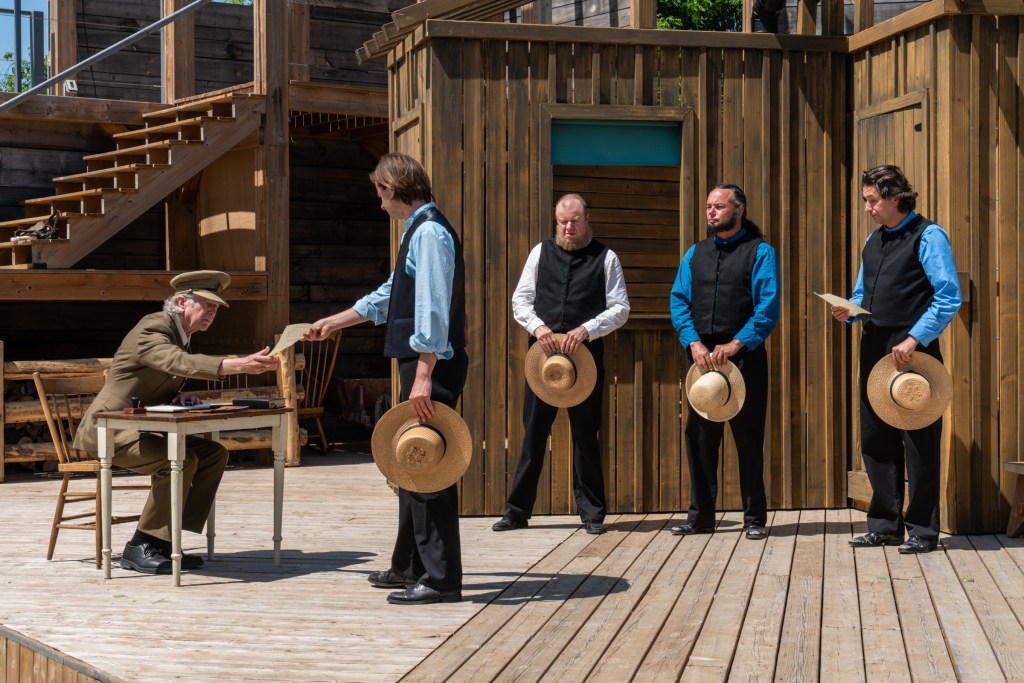
To me, the mark of a good play – or any piece of art for that matter – is that it leaves me with a new way of looking at the world around me, or that it shifts my perspective to one I may have never considered otherwise.
Director Severn Thompson’s production of playwright Anne Chislett’s 1981 play, Quiet in the Land, for the 2025 Blyth Festival does exactly that. First produced for the Blyth Festival 44 years ago, Quiet in the Land is being presented this season on the Blyth Festival’s outdoor Harvest Stage, the perfect setting for a story steeped in local history and a culture based around honest, hard work, steadfast faith in Christianity and a quiet pacifism that most of us who don’t follow the Amish way of life don’t know much about.
In my other life as a journalist and resident of Stratford, I’ve had precious few interactions with members of the local Amish and Mennonite communities in the surrounding rural townships. I’ve reported on issues affecting those communities a few times and I’ve interacted with members of those communities who own or work at local businesses. From the outside, it has been difficult to understand their way of life.
Through this production of Quiet in the Land, which frames the age-old conflict of long-held tradition against progressive change with a story about a father and son at odds over how to keep their people safe and a community on the brink of collapse unless its leaders adapt to changing times, I now have a better understanding of the culture, daily life and motivations that drive these communities to seek isolation and separation from the rest of the world.
With simple-yet-versatile, wooden set-pieces on stage, and the natural tree line at the back of the Blyth Community Centre property as a backdrop, I found myself easily transported to the closeknit Amish farming community somewhere near East Zorra Township set in the later years of the First World War. The correspondence read by characters on stage sent from other like-minded communities in nearby places like Baden and Wilmot, as well as the introduction of military conscription and the characters’ journey to Toronto to refuse military service on religious grounds, gives this play a wonderful grounding in local and national history, which I very much appreciate.
As the conflict between characters remains close to home and without much in the way of action or special effects, this production’s emotional depth rests entirely on the shoulders of its remarkable cast. The onstage development of relationships between characters like Christy Bauman (Randy Hughson) and his son, Yock Bauman (Landon Doak), as well as the lopsided love triangle of Yock, Kate Brubacher (Shelayna Christante) and Menno Miller (Richard Comeau), does much of the heavy lifting necessary to earn the emotional heft of the confrontation between the characters at the end of the second act.
The entrenched friendship between Christy and Zepp Brubacher (James Dallas smith), who support one another despite their growing division over how to lead the community forward, serves as important context to the conflict between father and son, between Christy and the rest of the community, and between the Amish people and the everchanging world beyond their fences.
Hughson, a veteran actor with 13 seasons at the Stratford Festival, is a worthy lynchpin for this story, bringing the authoritative presence and the almost sad resignation to remaining stagnant in the old way of life that his character needs to motivate the actions of the other characters on stage and drive the story forward.
As the light fades at the end of this production, I feel sorry for Christy despite the fact his character has shown little if any growth from beginning to end, or a willingness to at least try and understand the viewpoints of those he loves. The misery he feels is of his own making.
Quiet in the Land runs at the Blyth Festival until Aug. 23.
 NORTHERN ARTS PERSPECTIVE
Leave a comment