
By Galen Simmons
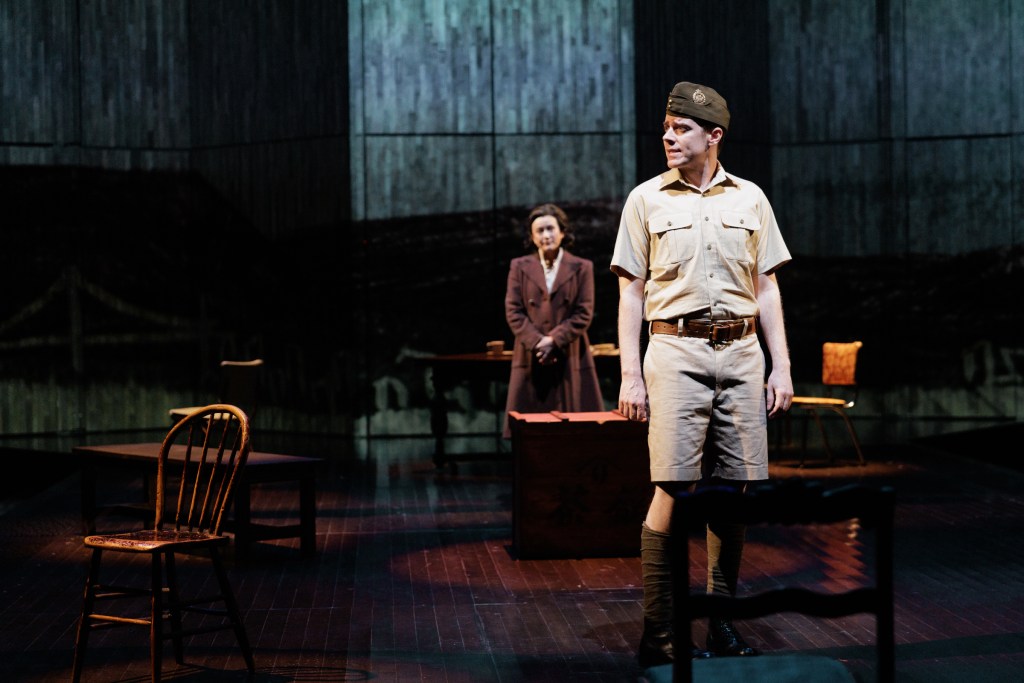
Do the protagonists in Forgiveness, a play adapted by actor and playwright Hiro Kanagawa from author Mark Sakamoto’s 2014 book, Forgiveness: A Gift from My Grandparents, actually find forgiveness in their hearts for the people and countries that did them wrong?
That’s the question I found myself asking at the end of director Stafford Arima’s 2025 Stratford Festival production. Having thought about it for a moment, I think it’s obvious they didn’t.
Mitsue Sakamoto (Yoshie Bancroft) did not forgive Canada and her fellow Canadians for labelling her and all Japanese Canadians as enemies of the state after Japan attacked the United States at Pearl Harbor in 1941, taking their homes and property, locking them away from their families in inhuman conditions and forcing them to work long days for low wages in support of the Canadian war effort without gratitude or even acknowledgement of their labour.
Ralph MacLean (Jeff Lillico) did not forgive Japan and the Japanese POW camp guards and commandant for capturing, starving and beating him, and killing his childhood friends and fellow soldiers. He also struggled to forgive himself for not doing more to save those friends he believes he left behind to die, despite there being little if anything he could have done differently.
Yet while they didn’t forgive, both Mitsue and Ralph – at least within the confines of this story – refuse to pass on their trauma to their children, thereby giving them the chance to live out their own Canadian dreams in whatever form they may take and without the pain of their parents.
This play is almost solely focused on hardships depicted artfully on stage with the use of fog, light and projection, be it the brutal reality of life in a Japanese internment camp in B.C. and the death of Mitsue’s father, Yosuke (Kanagawa), in the sugar-beet fields of rural Alberta, or Ralph’s suffering at the hands of POW guards and commandant Kato (also played by Kanagawa), who seems to take pleasure in torturing the Canadian solider mentally and spiritually, as well as physically.
But the crux of this story, as alluded to through events unfolding in their children’s lives in the late ‘60s depicted prior to and in between parallel wartime flashbacks from the perspectives of Mitsue and Ralph, takes place in the play’s final scene when Ralph and his wife, Phyllis (Jacklyn Francis), accept an invitation to dinner at the Sakatmotos’ home in Medicine Hat, Alta. The dinner is meant as an introduction between the MacLeans and Mitsue and her husband, Hideo (Michael Man), after their respective kids – Diane (Allison Lynch) and Stan (Douglas Oyama) – begin dating.
Though Ralph, Mitsue, Hideo, Mitsue’s mother, Tomi (Manami Hara), and, to a lesser extent, Phyllis have ample reason to distrust or even hate one another based on their wartime trauma, they put all that aside and come together amicably for a pleasant meal filled with laughter and light conversation, all for the sake of their kids and their potential future together.
In this production, the emotional heft of all the traumas witnessed on stage is lifted in an instant, which left me feeling hopeful both for the future of Diane and Stan, as well as for the future of this country. Credit for that goes to the considerable acting skills of everyone in this cast, as well as the real, emotional and historical context brought to bear through the production design, specifically with the use of projection to display real historical photographs and news clippings, and artwork.
Anyone in need of a reason to believe in this country again, despite all the hardships, hatred and horrendous acts of violence in our collective history, should see this play.
Forgiveness runs at the Tom Patterson Theatre until Sept. 27.
 NORTHERN ARTS PERSPECTIVE
Leave a comment