
By Galen Simmons
The stories we tell ourselves and those around us are influenced by our own experiences and the stories told to us as children and throughout our lives.
In the Stratford Festival’s production of The Diviners, author Morag Gunn (Irene Poole) is under pressure from her publisher to write her next, great novel. To do that, however, Morag must immerse herself in her own troubled past – something she’s long avoided with the help of a bottle. Morag’s daughter, Pique (Julie Lumsden), also pressures her mother to share that troubled past with her by threatening to leave home and find those answers on her own to gain a better understanding of who she is and where she comes from.
What unfolds in this play based on Margaret Laurence’s novel of the same name and adapted for the stage by Yvette Nolan and Vern Thiessen is an odyssey of sorts as Morag drifts back and forth between past and present. At one moment, she’s at her typewriter sharing a drink and speaking metaphorically with her neighbour, Royland (Anthony Santiago), in her small-town Ontario home. Then, as she’s trying to write her book, she’s suddenly adrift on a river of memories back in her hometown of Manawaka, Man., where she was raised by the loving and kind Christie Logan (Jonathan Goad), a worker at the town dump, after her parents died in a polio outbreak.
The story of Morag’s present circumstances is told through sequential flashbacks going back to when she was first adopted by Christie and met her teenage love and eventual father to her daughter, Métis classmate Jules (Jesse Gervais). She remembers the fire that killed Jules’ sister, Piquette (Caleigh Crow) – a memory that continues to haunt Morag’s present – and her unsatisfying and emotionally abusive marriage to her university professor, Brooke Skelton (Dan Chameroy), in Winnipeg and then Toronto.
As Morag remembers her past, she also remembers the stories of her Scottish ancestors’ journey to Canada told to her by Christie to connect her to the family that was taken from her. Christie also shares painful yet proud memories fighting alongside Colin Gunn, Morag’s father, in the First World War. In contrast to that and often in song, Morag also revisits stories of Métis history told to her by Jules, Piquette and their father and local moonshine-still operator, Lazarus (Josue Laboucane).
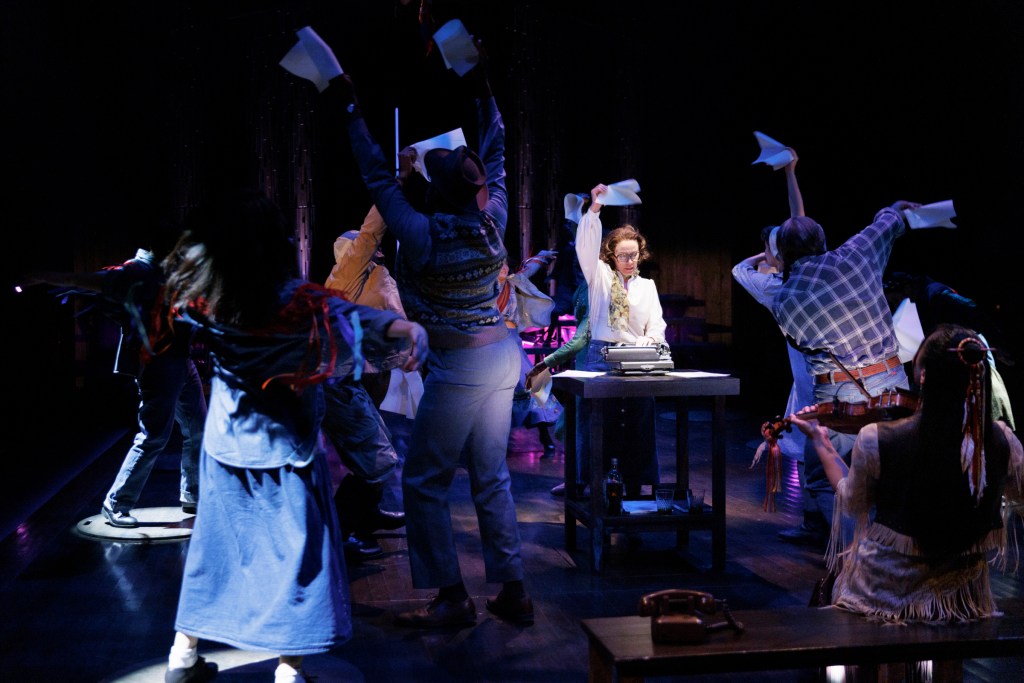
Directors Krista Jackson and Geneviève Pelletier and their entire production crew manage to capture that dreamlike feeling of trying to recall repressed memories from so long ago. The stage is artfully decorated, both above and below, in what could be considered junk from the Manawaka town dump, some of which comes to the forefront in specific memories before fading away again into the backdrop. Morag’s typewriter is also ever-present on stage, a visual cue for the audience that she is pushing herself to confront her past both to write her book and move on with her life.
Having actors play multiple roles across the present, past and in the stories told by other characters also contributes to that dreamlike feeling just as familiar faces can take on different roles when we are told stories about people from the past. And, having those same actors and characters from the past deliver pages of Morag’s book to her seated at her typewriter in the play’s present day truly makes all the sense in the world.
The use of Métis jigging and Métis fiddling on stage by consultant Darla Daniels, as well as traditional Scottish bagpiping by Morag’s ancestor, Piper Gunn (Gervais), serves to blend the two cultural contexts in which Morag was raised while also adding an intensity and urgency to her work in the present day.
Exceptional performances by Poole, Gervais, Goad, Laboucane and the entire cast make this world-premiere play a joy to watch.
The Diviners runs at the Tom Patterson Theatre until Oct. 2.
 NORTHERN ARTS PERSPECTIVE
Leave a comment